Fifty Blog Posts Can't Do What One Great Line Does
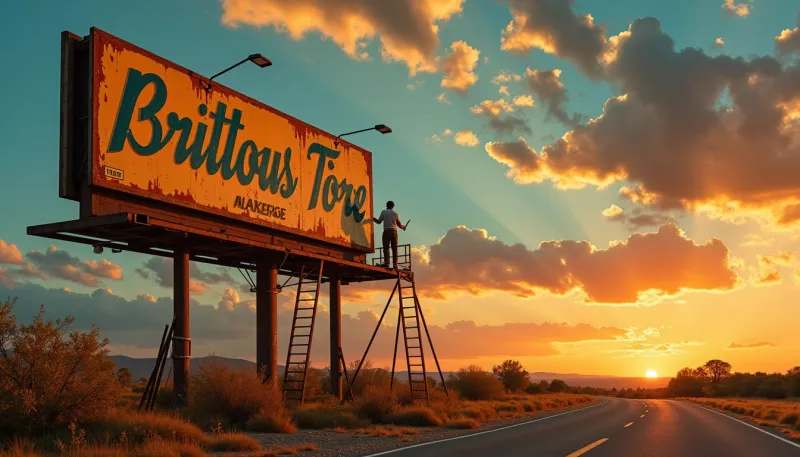
Photo: vintage highway billboard against open American landscape at dusk, via images.stockcake.com
Somewhere along the way, every marketing meeting in America turned into a conversation about cadence.
"We need to post three times a week."
"We're behind on the blog."
"Can we turn that webinar into six LinkedIn posts?"
Nobody in that meeting is asking the only question that matters: if someone saw all of it, what would they remember?
The honest answer, for most companies, is nothing. And that's the scandal nobody wants to say out loud — so we will. You don't have a content problem. You have a memorability problem, and more content makes it worse.
The Content Treadmill Is a Distraction Machine
Here's how the treadmill works. You publish something. It gets a modest bump of engagement. The analytics dashboard gives everyone a warm feeling. Then it vanishes into the scroll, replaced forty-five seconds later by someone's sourdough starter and a founder's hot take about AI.
Repeat two hundred times a year and you've built... nothing. No gravity. No shorthand. No reason for a buyer in Cleveland or Austin or Portland to think of you six months later when they finally have budget and a problem.
The dirty secret of content marketing is that volume and memory are inversely related more often than not. When everything is a post, nothing is a moment. Your audience isn't keeping a spreadsheet of your thought leadership. They're keeping, at absolute best, one fuzzy impression of who you are — and if you haven't sharpened that impression on purpose, the internet will sharpen it for you into a beige smear.
What a Tagline Actually Is (And Why Most Are Cowardly)
Let's clear something up. When we say "tagline," we don't mean the committee-sanctioned string of corporate comfort words hanging under your logo. "Empowering solutions for a connected world" is not a tagline. It's a surrender.
A real tagline is a compression of your entire position — the one idea your brand owns that nobody else can credibly claim. It's what's left when you boil the business down to its essence and have the nerve to say it out loud.
Think about the lines that actually live in the American brain. A diamond is forever. Just do it. The happiest place on earth. These aren't clever copywriting tricks. They're strategic bets about what a brand stands for, made once, with conviction, and then defended for decades.
That's the difference. Content is a stream. A tagline is a stake in the ground. Streams erode. Stakes hold.
The Math Nobody Runs: Fifty Posts vs. One Idea
Run the numbers on a typical year of content marketing at a mid-sized company. Two hundred pieces of content, easily 1,500 hours of collective work between writers, designers, and the marketing lead who reviews everything at 11 p.m.
Now ask: what's the compounding asset? What did all of it build?
Contrast that with the brands that put a fraction of that energy into one sharp idea and then hammered it consistently everywhere — packaging, sales decks, billboards on I-35, the founder's keynote, the office wall. That idea becomes a shortcut. Buyers use it to explain the company to their boss. Employees use it to explain the company to their families. When your customers start doing your positioning for you, you've won.
We're not saying stop publishing. Content has real jobs — SEO, sales enablement, staying visible. We're saying the creative center of gravity is backwards at most companies. Eighty percent of the creative energy goes into the stream, twenty percent into the idea. It should be flipped.
The Framework: Finding the One Idea You Actually Own
So how do you find your line? Not by brainstorming clever phrases over cold pizza. By interrogating the business. Four questions:
1. What do customers say about you when you're not in the room? Pull sales call recordings. Read every review. The idea you own is already being articulated by the people who pay you — usually clumsily, occasionally brilliantly. Your job is to find it and sharpen it, not invent a fictional version.
2. What can your competitor credibly say tomorrow? Strike everything on that list. If your line could be adopted by the biggest player in your category without anyone blinking, it's not a position. It's wallpaper.
3. What tension does your brand resolve? Every durable brand idea lives on a tension. Speed vs. quality. Craft vs. scale. Simplicity vs. power. Your tagline should sit on the fault line your customers actually feel — not the one your org chart finds comfortable.
4. Can a stranger repeat it after hearing it once? The bar test. Say your candidate line to someone outside your industry, then ask them to repeat it an hour later. If they get it roughly right, you're close. If they paraphrase it into generic mush, back to the drawing board.
Then Comes the Unsexy Part: Repetition
Here's where most brands fumble the handoff. They land on a great idea, launch it with a splash, and then get bored of it around month four because they're tired of hearing it. Their audience, meanwhile, has heard it twice.
The rule of thumb in American advertising has been true since the days of radio: people need to encounter an idea many times before it sticks. You will be sick of your line long before your market has even registered it. That boredom is not a signal to change. It's a signal that you're finally doing your job.
Put the line everywhere. Let it discipline your content, too — every post, every deck, every campaign should be a satellite orbiting the same idea. That's when the stream starts working, not because of volume, but because of coherence.
Make the Moment, Not the Feed
The brands Americans actually remember didn't earn a place in the culture by publishing on schedule. They earned it by committing to one sharp, ownable, repeatable idea — and having the stomach to say it the same way for years.
The feed will always want more. Give it less than it wants and more than it remembers.
One idea. Said boldly. Everywhere. Forever.
That's the strategy. The content can follow it.